
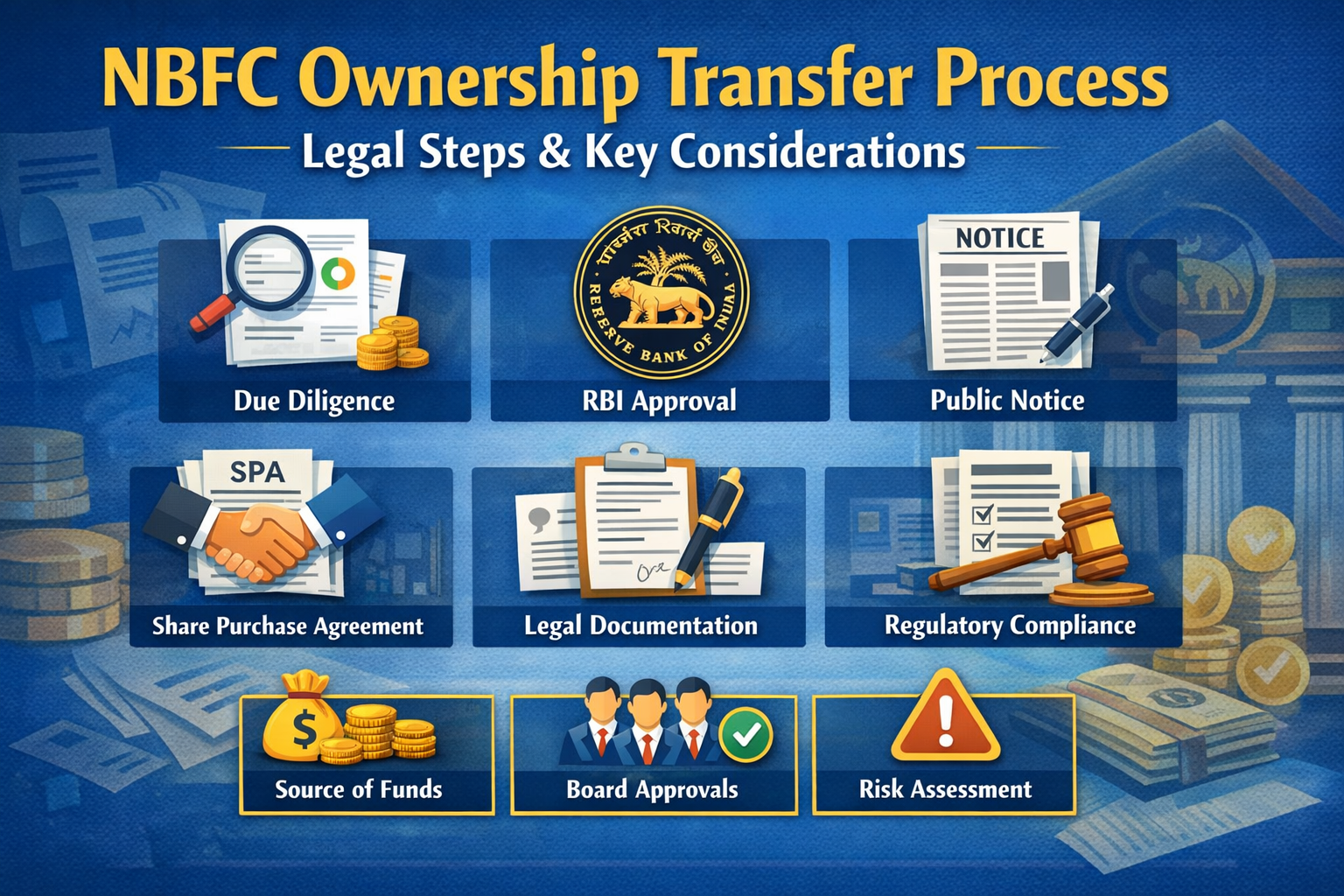
NBFC Ownership Transfer Process: Legal Steps & Key Considerations
The transfer of ownership in a Non-Banking Financial Company (NBFC) is a critical process that involves regulatory approvals, legal documentation, and strict compliance. Whether you are buying or selling an NBFC, understanding the ownership transfer process is essential to avoid legal complications.
This blog explains the legal steps and key considerations for NBFC ownership transfer in India.
What is NBFC Ownership Transfer?
NBFC ownership transfer refers to:
- Transfer of shares
- Change in promoters or shareholders
- Transfer of management/control
Such transactions often result in a change in control, which requires prior approval from the Reserve Bank of India.
When is RBI Approval Required?
RBI approval is mandatory in the following cases:
- Transfer of 26% or more shareholding
- Change in management or control
- Change in more than 30% of directors
- Merger or restructuring of NBFC
Approval must be obtained before executing the transaction.
Step-by-Step NBFC Ownership Transfer Process
1. Identify Buyer/Seller
The first step is to finalize:
- Buyer (acquirer)
- Seller (existing owner)
- Scope of transfer
2. Conduct Due Diligence
Due diligence is essential to evaluate:
- Financial health
- Loan portfolio and NPAs
- Legal liabilities
- Compliance status
This ensures transparency and risk assessment.
3. Sign Memorandum of Understanding (MoU)
The MoU outlines:
- Terms and conditions
- Valuation
- Timeline
- Payment structure
A token advance is usually paid at this stage.
4. Prepare Documentation
Key documents include:
- KYC documents of new promoters
- Net worth certificate
- Income Tax Returns
- Source of funds declaration
- Business plan
5. Apply for RBI Approval
Submit application to RBI with all required documents.
RBI evaluates:
- Fit and Proper criteria
- Financial strength
- Background of promoters
Approval generally takes 3–4 months.
6. Public Notice Requirement
Before finalizing ownership transfer:
- Publish notice in one national and one regional newspaper
- Allow 30 days for objections
This is mandatory under RBI guidelines.
7. Execute Share Purchase Agreement (SPA)
After RBI approval:
- Execute SPA
- Transfer shares
- Update ownership structure
8. Post-Transfer Compliance
After transfer:
- Update records with MCA
- Inform RBI
- Ensure ongoing compliance
Key Legal Considerations
✔ Compliance with RBI Guidelines
Strict adherence to RBI regulations is mandatory.
✔ Proper Documentation
Incomplete or incorrect documentation can delay approval.
✔ Source of Funds Verification
RBI requires transparency in funding sources.
✔ Board and Shareholder Approval
Both parties must approve the transaction legally.
✔ Drafting of Agreements
Ensure legally sound MoU and SPA to avoid disputes.
Financial Considerations
Before transferring ownership, evaluate:
- Valuation of NBFC
- Asset quality (NPAs)
- Profitability
- Future growth potential
Risks Involved
- Hidden liabilities
- Poor loan recovery
- Regulatory non-compliance
- Delay in RBI approval
Advantages of NBFC Ownership Transfer
- Quick business acquisition
- Existing customer base
- Ready operational setup
- Faster entry into financial sector
Compliance Checklist
Pre-Transfer
- ✔ Due diligence completed
- ✔ MoU signed
During Transfer
- ✔ RBI approval obtained
- ✔ Public notice issued
Post-Transfer
- ✔ ROC filings updated
- ✔ RBI informed
Timeline for Ownership Transfer
| Stage | Time Required |
|---|---|
| Due diligence | 2–3 weeks |
| RBI approval | 3–4 months |
| Public notice | 30 days |
| Final transfer | 1–2 weeks |
Conclusion
The NBFC ownership transfer process in India is a structured and compliance-driven procedure. From due diligence to RBI approval and post-transfer filings, each step must be handled carefully.
Understanding the legal steps and key considerations helps ensure a smooth, compliant, and successful ownership transfer.