
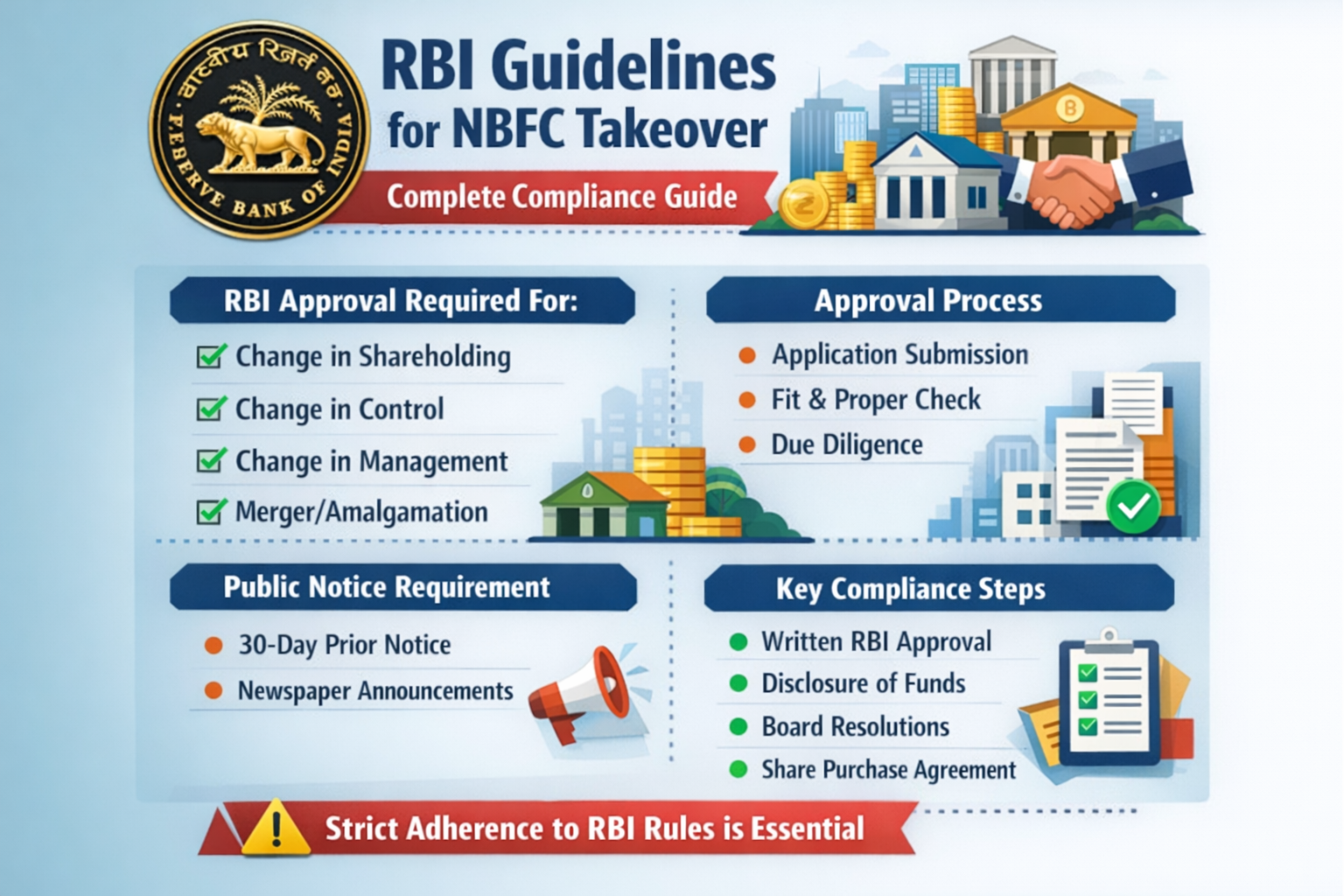
RBI Guidelines for NBFC Takeover: Complete Compliance Guide
The takeover of a Non-Banking Financial Company (NBFC) in India is a highly regulated process governed by the Reserve Bank of India. Any acquisition involving change in ownership, management, or control must strictly comply with RBI guidelines.
This blog provides a complete compliance guide on RBI rules for NBFC takeover, including approval requirements, legal provisions, and key regulatory checkpoints.
What is an NBFC Takeover as per RBI?
An NBFC takeover refers to:
- Acquisition of shares
- Change in control or management
- Transfer of ownership
- Merger or amalgamation
As per RBI regulations, any change in control requires prior written approval from RBI.
Legal Framework Governing NBFC Takeover
NBFC takeovers are regulated under:
- RBI Act, 1934
- Companies Act, 2013
- RBI Master Directions on NBFCs
These frameworks ensure financial stability, transparency, and investor protection.
When is RBI Approval Mandatory?
RBI approval is required in the following situations:
✔ Change in Shareholding
- Acquisition of 26% or more equity shares requires prior approval.
✔ Change in Control
- Any takeover or transfer of control—direct or indirect—needs approval.
✔ Change in Management
- If more than 30% of directors are changed, approval is mandatory.
✔ Merger or Amalgamation
- Any restructuring involving NBFCs requires RBI clearance.
RBI Prior Approval Process
1. Application Submission
The acquirer must submit an application to RBI with:
- Promoter details
- Financial statements
- Source of funds
- Business plan
2. Fit and Proper Evaluation
RBI assesses:
- Financial integrity
- Creditworthiness
- Professional experience
- Background of promoters
Strict “fit and proper” criteria must be met.
3. Due Diligence by RBI
RBI verifies:
- Compliance history of NBFC
- Asset quality
- Regulatory track record
4. Grant of Approval
Approval is granted in writing. Without it, the transaction cannot proceed.
Public Notice Requirement
RBI mandates a 30-day prior public notice before takeover:
- One national newspaper
- One local (vernacular) newspaper
The notice must include:
- Details of transferee
- Reason for transfer
- Intention of takeover
This ensures transparency and stakeholder awareness.
Key Compliance Requirements
✔ Written RBI Approval
Approval must be obtained before executing any transaction.
✔ Disclosure of Source of Funds
Complete transparency is required regarding funding.
✔ Board Resolutions
Both buyer and seller must approve the transaction.
✔ Share Purchase Agreement (SPA)
Legal agreement must be executed post-approval.
Situations Where RBI Approval May Not Be Required
In certain cases, prior approval may not be needed:
- Increase in shareholding beyond 26% due to buyback or capital reduction (with court approval)
- However, RBI must be informed within a specified time
Post-Takeover Compliance
After completing the takeover:
- Inform RBI about changes
- Update records with MCA (Ministry of Corporate Affairs)
- Ensure ongoing compliance with NBFC norms
Failure to comply may result in penalties or cancellation of registration.
Common Compliance Mistakes to Avoid
- ❌ Proceeding without RBI approval
- ❌ Incomplete documentation
- ❌ Ignoring public notice requirement
- ❌ Not verifying source of funds
- ❌ Poor due diligence
Importance of RBI Guidelines
RBI regulations ensure:
- Financial stability
- Protection of depositors
- Transparency in ownership changes
- Prevention of fraud and misuse
Conclusion
NBFC takeover in India is a compliance-driven process that requires strict adherence to RBI guidelines. From prior approval to public notice and post-acquisition compliance, every step must be carefully followed.
A proper understanding of RBI regulations helps ensure a smooth, legal, and successful NBFC takeover.