
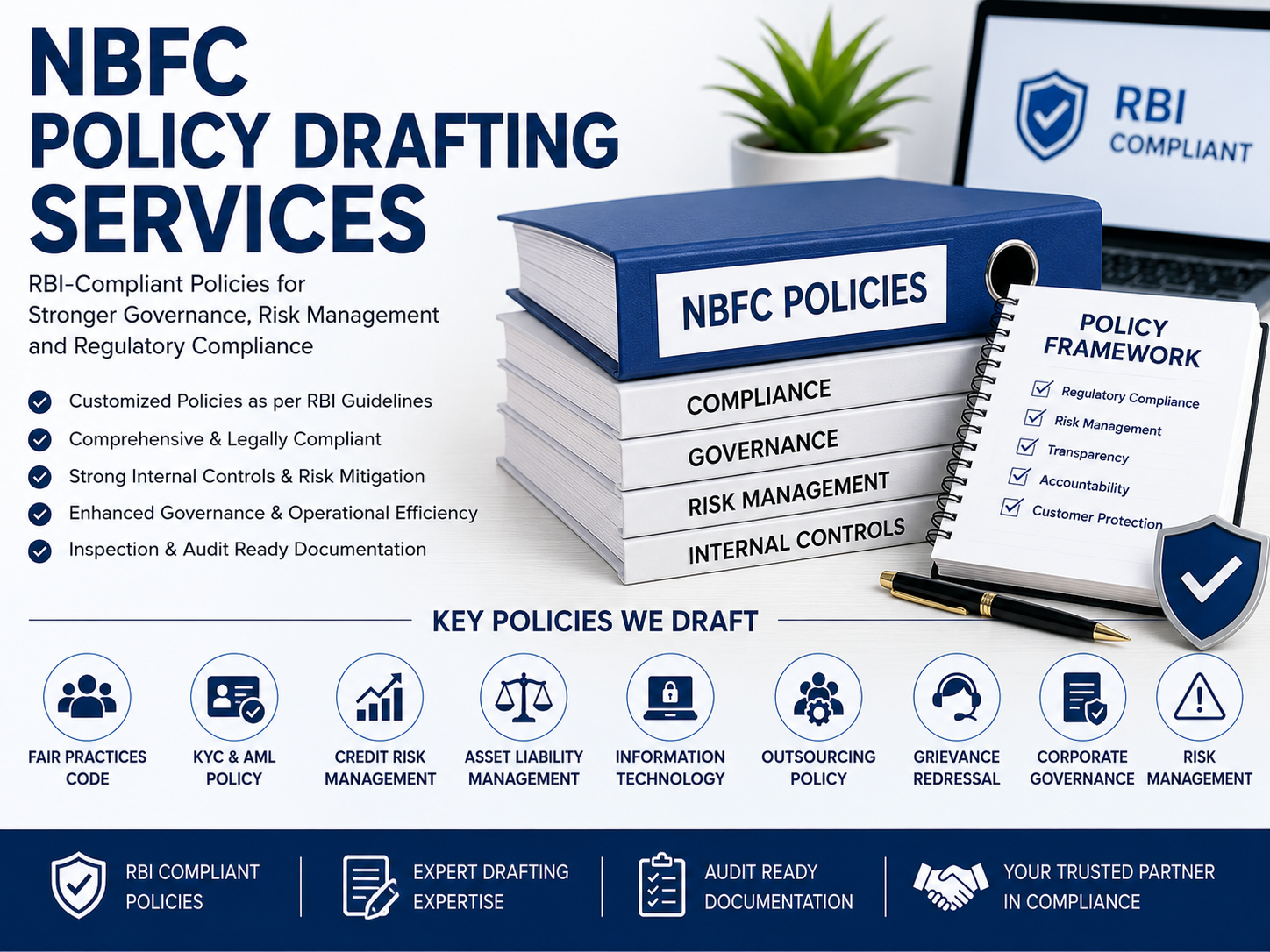
NBFC Policy Drafting Services: Building a Strong Compliance Framework for Financial Institutions
Introduction
Non-Banking Financial Companies (NBFCs) operate in a highly regulated environment governed by the Reserve Bank of India (RBI). To ensure regulatory compliance, effective risk management, and operational efficiency, NBFCs are required to establish and maintain various internal policies and procedures.
Well-drafted policies form the backbone of a compliant and professionally managed NBFC. They provide guidance to management, employees, stakeholders, and regulators while ensuring that the organization adheres to applicable laws and RBI guidelines. Professional NBFC Policy Drafting Services help companies develop customized, legally compliant, and operationally effective policies that support sustainable growth.
What is NBFC Policy Drafting?
NBFC policy drafting involves preparing formal internal documents that define the company's governance structure, operational procedures, compliance framework, risk management processes, and customer service standards.
These policies are designed to:
-
Meet RBI regulatory requirements
-
Establish internal controls
-
Promote transparency and accountability
-
Minimize operational risks
-
Ensure consistency in decision-making
-
Protect the interests of customers and stakeholders
Every NBFC must adopt policies that align with its business model, size, and regulatory obligations.
Importance of Policy Drafting for NBFCs
Regulatory Compliance
RBI mandates various policies that NBFCs must formulate and implement as part of their compliance framework.
Risk Management
Clearly defined policies help identify, monitor, and mitigate financial, operational, and compliance risks.
Corporate Governance
Policies establish accountability and governance mechanisms for management and the board of directors.
Operational Efficiency
Documented procedures improve consistency and efficiency across business operations.
Regulatory Inspection Readiness
Comprehensive policies demonstrate compliance during RBI inspections and audits.
Key Policies Required for NBFCs
Fair Practices Code (FPC)
This policy governs customer interactions and ensures transparency in lending and recovery practices.
Key areas include:
-
Loan application processing
-
Interest rate disclosure
-
Recovery procedures
-
Customer grievance handling
KYC and Anti-Money Laundering Policy
The KYC and AML policy helps prevent money laundering and financial crimes by establishing customer identification and monitoring procedures.
Credit Risk Management Policy
Defines credit appraisal, approval, monitoring, and recovery processes to minimize lending risks.
Asset Liability Management (ALM) Policy
Provides a framework for managing liquidity, interest rate risks, and balance sheet stability.
Information Technology (IT) Policy
Establishes cybersecurity, data protection, system management, and technology governance standards.
Outsourcing Policy
Regulates third-party service providers and outsourcing arrangements while ensuring compliance with RBI requirements.
Recovery Policy
Specifies ethical and lawful debt recovery procedures and customer communication practices.
Grievance Redressal Policy
Provides a structured mechanism for handling customer complaints and dispute resolution.
Corporate Governance Policy
Defines board responsibilities, management oversight, compliance monitoring, and ethical business practices.
Risk Management Policy
Establishes processes for identifying, assessing, and mitigating business risks.
Benefits of Professional NBFC Policy Drafting Services
Customized Policy Development
Policies are tailored according to the NBFC's business activities, scale, and regulatory requirements.
RBI-Compliant Documentation
Professional consultants ensure policies comply with the latest RBI circulars and regulatory guidelines.
Risk Mitigation
Well-structured policies help reduce legal, operational, and financial risks.
Strong Internal Controls
Policies establish effective checks and balances across organizational functions.
Regulatory Confidence
Comprehensive policy documentation improves preparedness for RBI inspections and audits.
Policy Drafting Process
Step 1: Business Assessment
Consultants review the NBFC's business model, operations, products, and regulatory obligations.
Step 2: Gap Analysis
Existing policies and compliance frameworks are evaluated to identify gaps and deficiencies.
Step 3: Drafting of Policies
Customized policies are prepared in accordance with RBI regulations and industry best practices.
Step 4: Review and Approval
Management and board members review the drafted policies before formal adoption.
Step 5: Implementation Support
Assistance is provided for policy rollout, employee training, and operational integration.
Step 6: Periodic Updates
Policies are reviewed and updated periodically to reflect regulatory changes and business developments.
Common Challenges in NBFC Policy Management
NBFCs often face:
-
Frequent regulatory changes
-
Lack of standardized documentation
-
Inadequate internal controls
-
Compliance gaps
-
Poor policy implementation
-
Limited in-house expertise
Professional policy drafting services help address these challenges effectively.
Why Choose Professional NBFC Policy Drafting Services?
Expert consultants provide:
-
RBI-compliant policy frameworks
-
Customized policy drafting
-
Governance and compliance advisory
-
Risk management documentation
-
Policy review and updating services
-
Board-approved policy structures
-
Regulatory inspection preparedness
Their expertise ensures that the NBFC maintains a strong compliance culture and operational excellence.
Consequences of Inadequate Policies
Poorly drafted or outdated policies can lead to:
-
Regulatory penalties
-
Increased compliance risks
-
Operational inefficiencies
-
Internal control failures
-
Customer disputes
-
Adverse audit observations
-
Reputational damage
A robust policy framework significantly reduces these risks.
Best Practices for NBFC Policy Management
To maintain an effective compliance framework, NBFCs should:
-
Regularly review and update policies
-
Align policies with RBI regulations
-
Ensure board approval and oversight
-
Conduct periodic compliance audits
-
Train employees on policy requirements
-
Monitor implementation effectiveness
-
Maintain proper documentation and records
Conclusion
Policy drafting is a critical aspect of building a compliant, transparent, and efficient NBFC. Well-designed policies not only help meet RBI regulatory requirements but also strengthen governance, risk management, and operational performance.
Professional NBFC Policy Drafting Services provide comprehensive support in developing customized, RBI-compliant policies that safeguard the organization's interests and support long-term growth. By investing in a strong policy framework, NBFCs can enhance regulatory compliance, improve customer trust, and achieve sustainable success in the financial services sector.