
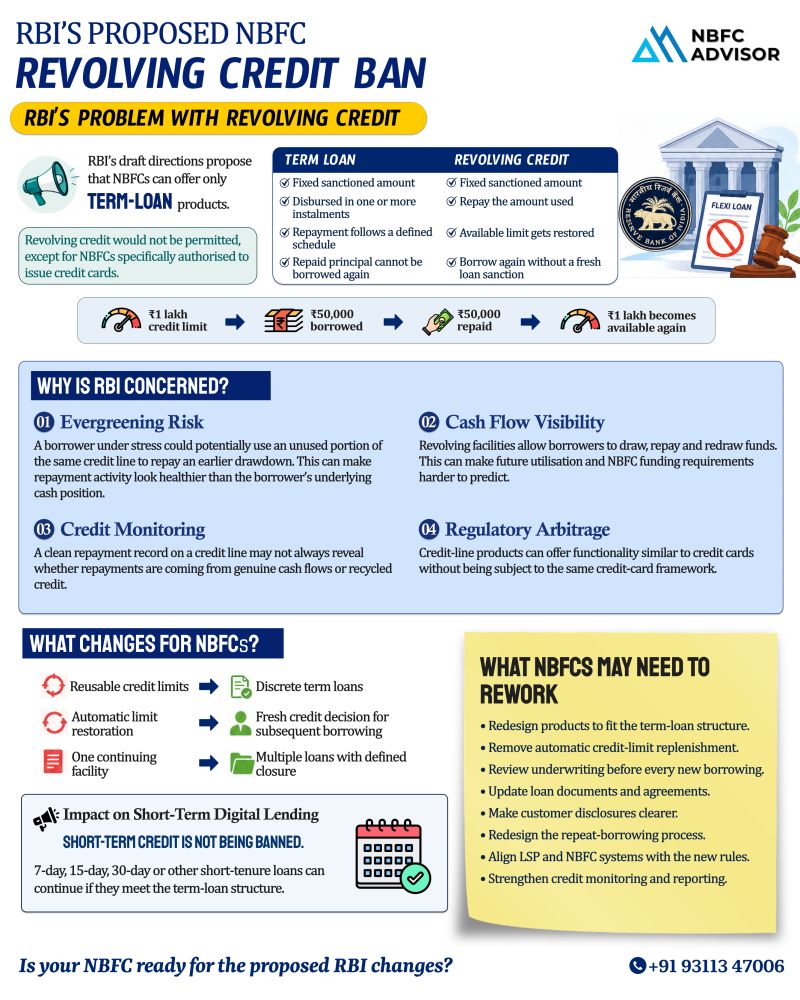
In early August 2026, the Reserve Bank of India released draft amendments to the Non-Banking Financial Companies – Credit Facilities Directions, 2025, that could fundamentally reshape how non-banking financial companies design and deliver credit. The core proposal is straightforward yet far-reaching: NBFCs shall offer only term-loan products and shall not offer any revolving credit facilities, with a narrow exception for entities specifically authorised by the RBI to issue credit cards.
This move has triggered intense discussion across the NBFC sector, fintech partnerships, digital lending platforms, and investor circles. While short-term credit itself is not being banned, the structure of reusable, auto-replenishing credit lines faces a clear regulatory line. The draft is currently open for public comments (deadline reported as 28 August 2026), and its final form will determine the precise contours of compliance.
This article examines the proposal in detail—its definitions, regulatory rationale, operational implications, industry reactions, and the practical steps NBFCs may need to take.
Background: The Evolving Regulatory Landscape for NBFC Credit
NBFCs have played a pivotal role in expanding credit access in India, particularly to underserved segments, MSMEs, and retail borrowers. Over the past decade, product innovation accelerated. Flexi loans, credit lines, overdraft-style facilities, supply-chain finance products, and digital “buy now, pay later” or instant credit offerings proliferated. Many of these products allowed borrowers to draw, repay, and redraw within a sanctioned limit without a fresh credit assessment each time.
RBI has long maintained that pure revolving credit was not freely available to NBFCs in the same manner as banks. However, the practical design of many products blurred the boundary between term loans and revolving facilities. Supervisory observations over recent inspection cycles appear to have heightened concerns around evergreening risks, cash-flow opacity, and potential regulatory arbitrage relative to the stricter framework governing credit cards.
The November 2025 Credit Facilities Directions consolidated earlier instructions. The August 2026 draft amendments now seek to introduce precise definitions and an explicit restriction, deleting earlier provisions related to demand/call loans and inserting a new section on restrictions on revolving credit facilities.
The Core Proposal and Key Definitions
Under the draft, NBFCs are restricted to offering credit products that meet the definition of a term loan. Revolving credit is prohibited except for RBI-authorised credit-card issuers (currently a very small set of entities).
The draft defines the two categories with precision:
Term loan is a fund-based credit facility of a fixed principal amount that satisfies both of the following conditions: (a) The sanctioned limit is disbursed in one or more instalments and is repayable in accordance with a predetermined amortisation schedule—either through periodic instalments or as a bullet repayment on the stated due date(s). (b) Once disbursed, the sanctioned limit cannot be restored or replenished upon repayment of the whole or any part of the principal amount.
Revolving credit is defined residually as any fund-based credit facility that does not meet the definition of a term loan.
This binary approach is deliberate. Any facility that automatically restores the available limit after repayment, or that lacks a fixed principal amount with a predetermined repayment schedule, falls into the prohibited category.
The amendments also remove the earlier framework for demand/call loans, signalling a broader preference for structured, amortising credit over open-ended facilities.
Why Is the RBI Concerned? Four Interlinked Risks
The regulatory concerns, reflected in both the draft’s structure and subsequent public commentary, centre on four interrelated issues.
1. Evergreening Risk A borrower under stress can use an unused portion of the same credit line to repay an earlier drawdown. This creates the appearance of regular repayment activity even when the underlying cash position has deteriorated. Over time, such practices can mask rising indebtedness and delay recognition of stress. In a high-growth unsecured retail and digital lending environment, the risk of systematic evergreening becomes material.
2. Cash-Flow Visibility and Funding Predictability Revolving facilities allow borrowers to draw, repay, and redraw frequently. For the NBFC, this makes future utilisation patterns harder to forecast. Accurate projection of funding requirements, asset-liability management, and capital planning becomes more complex. In contrast, term loans with fixed repayment schedules provide clearer visibility into expected cash inflows.
3. Credit Monitoring Challenges A clean repayment track record on a revolving line does not necessarily indicate genuine cash-flow strength. Repayments may be funded by fresh drawdowns rather than operational income or savings. Distinguishing between healthy utilisation and recycled credit requires more intensive, continuous monitoring—something that is operationally demanding at scale, especially in digital lending models with high volumes and lower-ticket sizes.
4. Regulatory Arbitrage Credit-line products can deliver functionality similar to credit cards—on-tap availability, repeated utilisation, and interest charged only on outstanding balances—without being subject to the same regulatory framework that governs card issuance, customer protection norms, and risk management for credit cards. By restricting revolving credit primarily to authorised card issuers, the RBI aims to close this gap.
These concerns are not abstract. Rapid growth in unsecured retail credit and fintech-NBFC partnerships in recent years has repeatedly drawn supervisory attention. The draft represents an attempt to impose structural discipline rather than merely rely on conduct or disclosure requirements.
What Changes Operationally for NBFCs?
If the draft is finalised largely in its current form, several product and process features will require redesign:
- Reusable credit limits must convert into discrete term loans.
- Automatic limit restoration after repayment must stop.
- Subsequent borrowing will generally require a fresh credit decision, underwriting, and sanction.
- One continuing facility may need to be replaced by multiple loans, each with defined closure.
- Loan documentation, sanction letters, and customer agreements will need updating to reflect non-replenishable limits and predetermined repayment schedules.
- Customer disclosures must clearly communicate that the facility is not revolving.
- Repeat-borrowing journeys—especially in app-based digital lending—will need re-engineering so that each new drawdown triggers assessment rather than automatic availability.
- Systems integrating Lending Service Providers (LSPs) with NBFCs must align with the new structure.
- Credit monitoring and reporting frameworks will need strengthening to track the transition and ongoing compliance.
Importantly, short-term credit is not prohibited. A 7-day, 15-day, 30-day, or any other short-tenor loan remains permissible provided it is structured as a true term loan: fixed amount, predetermined repayment schedule (even if bullet), and no automatic restoration of the limit upon repayment. The distinction is structural, not temporal.
Impact Across Product Categories
The breadth of the definition has raised questions about several existing products:
- Flexi personal loans and overdraft-style facilities: These are most directly affected if they allow repeated drawdown and automatic limit restoration.
- Loans against shares or mutual fund units: Depending on design, some variants function more like revolving facilities.
- Supply-chain and inventory financing: Working-capital products that operate on a revolving basis may require restructuring into discrete term facilities or other permitted forms.
- Digital lending and UPI-linked credit: Instant credit lines, pay-later products, and certain embedded finance offerings that restore limits automatically could fall within the restricted category.
- Credit cards: Explicitly carved out for authorised issuers, preserving the existing framework for that product.
Industry estimates have suggested that products with features resembling revolving credit could represent exposure in the range of ₹2 lakh crore or more across the sector, with significant concentration among larger retail-focused NBFCs. Growth rates in these segments have been robust (often cited in the 15–20% range), and they contribute meaningfully to fee income and customer stickiness in some portfolios.
Industry Response and Regulatory Clarification
The draft prompted an immediate market reaction, with shares of several NBFCs declining sharply in the days following its release. Larger players and industry bodies have sought engagement with the RBI, arguing that a blanket prohibition could disrupt established products serving MSMEs and individuals, create an uneven playing field relative to banks, and constrain credit access without adequate evidence of systemic problems in the existing portfolio.
RBI Deputy Governor Shirish Chandra Murmu subsequently clarified that revolving credit as such was already not permitted for NBFCs, and that the draft primarily aims to bring greater clarity to the existing regulatory position rather than to halt legitimate business activities. He indicated that the regulation is intended to ensure business is conducted in a risk-appropriate manner and should not come in the way of ongoing activities when properly structured.
This clarification has been welcomed, yet uncertainty remains around the precise interpretation of products that sit near the boundary—those structured as term loans on paper but used in practice like revolving lines. The final directions, any accompanying FAQs, and supervisory guidance will be critical.
Preparation Roadmap for NBFCs
NBFCs that currently offer or plan to offer products with revolving features would be well advised to begin a structured review:
- Product inventory and classification — Map every credit product against the draft definitions of term loan and revolving credit. Identify those that fail the non-replenishment test.
- Redesign of non-compliant products — Convert reusable limits into discrete term loans with fixed amounts and predetermined schedules. Explore bullet-repayment structures where appropriate for short-tenor needs.
- Underwriting and decisioning processes — Strengthen the capability to perform fresh credit assessments efficiently for repeat borrowers, leveraging data and technology without compromising quality.
- Technology and systems — Update core lending systems, limit management engines, and LSP interfaces to prevent automatic restoration and to support multiple discrete loan accounts.
- Documentation and disclosures — Revise agreements, sanction letters, and customer communications for clarity and compliance.
- Monitoring and reporting — Enhance early-warning systems and portfolio analytics focused on cash-flow quality and utilisation patterns.
- Customer communication and transition planning — Prepare clear messaging for existing customers whose facilities may need to be restructured or closed and replaced.
- Feedback to the regulator — Participate constructively in the consultation process before the 28 August deadline, providing data on portfolio performance, customer impact, and alternative risk-mitigation approaches.
Fintechs and LSPs partnered with NBFCs will need parallel alignment, as product design, customer journeys, and data flows are often jointly managed.
Broader Implications
For borrowers, the shift may reduce the seamless “always-available” nature of certain credit lines and introduce more friction for successive borrowings. At the same time, clearer product structures and stronger underwriting could improve long-term credit quality and reduce the risk of over-indebtedness.
For the financial system, the proposal reinforces a preference for amortising credit with transparent repayment profiles. It also seeks to align the functional treatment of revolving facilities more closely with the specialised regime applicable to credit cards.
Banks, which retain greater flexibility in offering overdraft and cash-credit facilities, may see a relative competitive advantage in certain working-capital segments—an outcome that some NBFCs have flagged as creating regulatory asymmetry.
Conclusion
The RBI’s draft directions on revolving credit represent a significant structural intervention in NBFC lending. By drawing a clear line between term loans and revolving facilities, the regulator aims to address risks of evergreening, improve cash-flow visibility, strengthen credit monitoring, and reduce regulatory arbitrage. Short-term credit remains viable when properly structured as term loans; what is being constrained is the automatic, reusable nature of credit limits.
Whether the final directions retain the current breadth or incorporate calibrated carve-outs and transitional arrangements will depend on the quality of feedback received and the regulator’s assessment of systemic risk versus credit-flow considerations. For NBFCs, the prudent course is to treat the draft as a serious signal, conduct a thorough product and process review, and prepare for a lending model in which every subsequent borrowing is, in substance, a fresh credit decision.
The coming weeks of consultation and the eventual final notification will shape the next phase of product innovation and risk management in India’s non-bank financial sector. Institutions that adapt early—redesigning products, strengthening underwriting, and enhancing transparency—will be better positioned to navigate the new landscape while continuing to serve the credit needs of households and enterprises.