
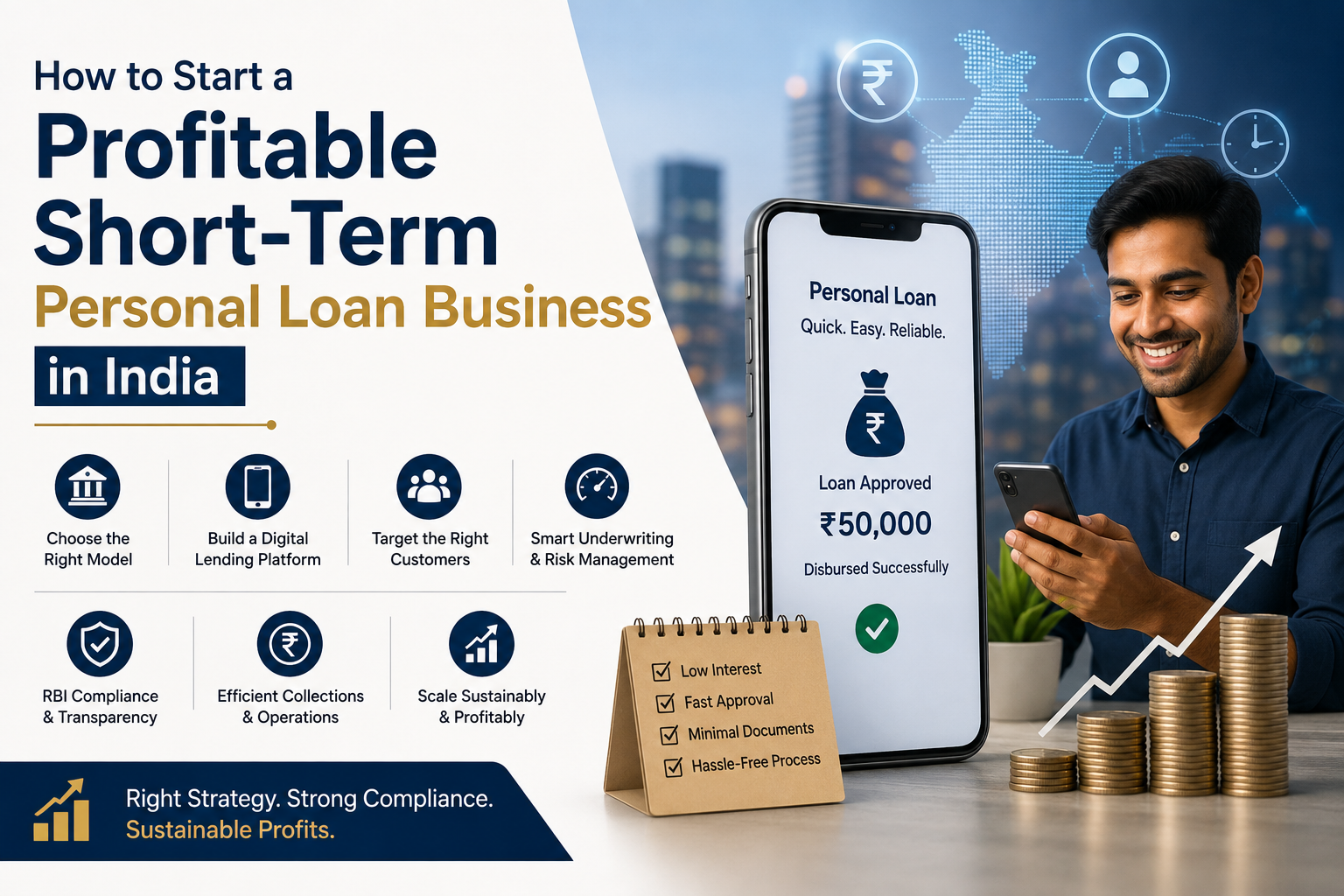
India’s growing digital economy, expanding salaried population and increasing demand for emergency credit have created a significant market for short-term personal loans.
Customers often require small loans for medical expenses, rent, utility bills, education fees, travel, vehicle repairs or temporary cash-flow shortages. Traditional banks may not always process such small and urgent loan requests quickly, particularly where the applicant has a limited credit history or irregular income.
This creates an opportunity for technology-driven lenders capable of offering fast, transparent and appropriately priced personal loans.
However, a profitable short-term lending business cannot be built merely by launching a mobile application and charging high interest. Lending is a regulated financial activity involving credit risk, fraud risk, data privacy, customer protection, liquidity management and recovery obligations.
The most sustainable lenders earn money by selecting the right customers, controlling defaults, reducing customer-acquisition costs, encouraging responsible repeat borrowing and operating through a compliant legal structure.
This guide explains how to start a profitable short-term personal loan business in India while complying with the regulatory framework applicable in 2026.
What Is a Short-Term Personal Loan Business?
A short-term personal loan business provides unsecured loans to individuals for a relatively brief period.
Depending on the product, the loan may have:
- A ticket size between ₹5,000 and ₹2 lakh
- A repayment period between one and twelve months
- Weekly, fortnightly or monthly instalments
- Digital customer onboarding
- Automated credit assessment
- Direct bank-account disbursement
- Digital repayment through eNACH, UPI or other approved channels
Unlike secured loans, these facilities are generally not backed by property, gold or another physical asset. The lender therefore relies on the borrower’s income, banking behaviour, credit history and repayment capacity.
The absence of security makes underwriting and collection management especially important.
First Choose the Correct Legal Business Model
Before building an application or advertising loan products, the promoter must decide who will legally lend the money.
There are three practical business models.
Model 1: Obtain an NBFC Licence and Lend from Your Own Balance Sheet
A company intending to conduct lending as its principal business generally requires registration as an NBFC under Section 45-IA of the Reserve Bank of India Act, 1934.
A new applicant seeking conventional lending registration must be incorporated as a company and generally maintain a minimum Net Owned Fund of ₹10 crore. RBI examines the applicant’s promoters, directors, capital sources, business plan and operational readiness before granting the Certificate of Registration.
For a short-term personal loan business, the appropriate category will ordinarily be an Investment and Credit Company, or NBFC-ICC.
This model provides greater control over:
- Credit policy
- Interest-rate policy
- Loan-book ownership
- Customer relationships
- Product design
- Collection strategy
- Long-term enterprise value
However, it requires substantial capital, an experienced management team, regulatory reporting, provisioning, risk management and continuous RBI compliance.
A promoter should not collect public money or begin lending as an NBFC merely because a company has been incorporated. The lending business should commence only after the required regulatory approval has been obtained.
Model 2: Operate as a Lending Service Provider
A fintech company can operate as a Lending Service Provider, or LSP, by partnering with an RBI-regulated bank or NBFC.
An LSP may assist the regulated lender with activities such as:
- Customer acquisition
- Application processing
- Data collection
- Credit assessment support
- Loan servicing
- Repayment monitoring
- Customer support
- Collection assistance
The regulated entity remains the actual lender and continues to be responsible for regulatory compliance and the conduct of the LSP. RBI requires the relationship between the regulated entity and LSP to be governed by a clear contractual agreement, supported by due diligence and ongoing monitoring.
Under this model, the fintech may earn:
- Customer-acquisition fees
- Loan-origination fees
- Technology charges
- Servicing fees
- Collection incentives
- Performance-linked commercial fees
These amounts should be paid by the regulated lender in accordance with the agreement. An LSP cannot separately collect undisclosed charges from borrowers.
This model requires less regulatory capital than owning an NBFC and can be a suitable starting point for promoters who have strong technology, distribution or underwriting capabilities.
Model 3: Work as a DSA or Lead-Generation Company
A Direct Selling Agent or lead-generation business identifies prospective borrowers and refers them to banks or NBFCs.
The DSA does not sanction or disburse the loan. It normally receives a commission for successfully sourced customers.
This model has the lowest capital requirement, but it also offers limited control over pricing, underwriting, approval rates and customer experience.
It can be used to test a particular customer segment before investing in a full LSP platform or NBFC structure.
Select a Clearly Defined Target Market
A short-term loan company should not begin by lending to everyone.
The promoter should choose a narrow customer segment whose income and repayment behaviour can be reasonably evaluated.
Possible segments include:
- Salaried employees receiving income through a bank account
- Employees of selected corporate organisations
- Gig workers with stable platform earnings
- Self-employed professionals
- Existing customers of a digital marketplace
- Employees requiring salary advances
- Customers with predictable recurring income
- Borrowers with thin but acceptable credit files
A product designed for salaried employees should not use the same underwriting rules as a product for gig workers.
Each segment has different income patterns, default risks, documentation requirements and collection challenges.
A focused initial segment makes it easier to create accurate scorecards, marketing messages and repayment schedules.
Design a Responsible Loan Product
A profitable product must also be affordable for the borrower.
Important product decisions include:
- Minimum and maximum loan amount
- Repayment tenure
- Instalment frequency
- Interest-rate methodology
- Processing fee
- Late-payment treatment
- Cooling-off period
- Eligibility criteria
- Repeat-loan rules
- Prepayment conditions
Very short loans can appear attractive because capital is recycled quickly. However, frequent onboarding costs and high first-payment defaults can make them expensive to operate.
The repayment date should match the borrower’s cash-flow cycle. For salaried customers, instalments can be aligned with salary dates. For gig workers, smaller periodic repayments may be more suitable.
The lender should avoid automatically increasing a borrower’s credit limit. Under RBI’s Digital Lending Directions, the regulated lender must assess the borrower’s economic profile, including age, occupation and income, and may not automatically increase a digital credit limit without an explicit borrower request that has been evaluated and recorded.
Understand the Economics of Each Loan
Profitability should be measured at the individual-loan and customer-cohort level.
A simple contribution formula is:
Loan contribution = Interest income + permitted fees − cost of funds − acquisition cost − expected credit loss − technology cost − servicing and recovery cost
Consider an illustrative ₹30,000 loan with a tenure of 120 days:
| Particulars | Illustrative Amount |
|---|---|
| Interest income | ₹2,800 |
| Processing fee | ₹600 |
| Total gross revenue | ₹3,400 |
| Cost of funds | ₹1,200 |
| Customer-acquisition cost | ₹400 |
| KYC, bureau and payment cost | ₹200 |
| Expected credit loss | ₹750 |
| Servicing and collection cost | ₹250 |
| Estimated contribution | ₹600 |
This example is only for explaining unit economics and is not a recommended pricing structure.
The actual Annual Percentage Rate must be calculated after considering the interest, processing fee and other applicable costs. A high advertised interest rate does not necessarily create profit if the company has expensive customer acquisition, fraud losses or poor collections.
The most important profitability metrics include:
- Approval rate
- Disbursement rate
- Customer-acquisition cost
- First-payment default
- Thirty-day delinquency
- Ninety-day delinquency
- Recovery rate
- Expected credit loss
- Cost per serviced account
- Repeat-customer percentage
- Contribution per loan
- Lifetime value of a customer
The company should separately analyse new and repeat borrowers. Repeat customers often have lower acquisition costs and better repayment data, making them more valuable than constantly acquiring unknown borrowers.
Build a Strong Credit-Underwriting System
Underwriting is the core of a profitable lending business.
The lender should evaluate whether the customer has both the intention and financial capacity to repay.
A practical underwriting system may examine:
- Identity and KYC information
- Age and residence
- Employment stability
- Monthly income
- Salary credits
- Bank-account cash flows
- Existing loan obligations
- Credit-bureau history
- Recent credit enquiries
- Debt-to-income ratio
- Previous repayment behaviour
- Fraud indicators
- Device and application consistency
The company should not depend entirely on a single credit score.
A borrower with a high score may already have substantial debt, while a new-to-credit customer may have a limited bureau history but stable income and banking behaviour.
The underwriting model should combine bureau information, income verification, bank data, fraud controls and product-specific policy rules.
High-risk cases should be referred for manual review rather than approved automatically.
Control Fraud before Controlling Defaults
Credit risk and fraud risk are different.
Credit risk arises when a genuine borrower is unable or unwilling to repay. Fraud risk arises when an applicant uses false identity, manipulated income documents, stolen information or coordinated accounts to obtain a loan.
Common fraud controls include:
- PAN and identity verification
- Bank-account ownership validation
- Face match and liveness verification
- Duplicate-device checks
- Duplicate-bank-account checks
- Employer verification
- Document-tampering detection
- Unusual application velocity checks
- IP-address and location analysis
- Fraud blacklists
- Manual review of suspicious applications
The company should test whether new fraud rules reduce losses without rejecting too many genuine applicants.
Provide Transparent Pricing through the KFS
Borrowers must understand the complete cost of the loan before accepting it.
The Key Facts Statement should communicate:
- Sanctioned amount
- Net disbursed amount
- Interest rate
- Annual Percentage Rate
- Processing charges
- Third-party charges
- Repayment schedule
- Total repayment
- Penal charges
- Grievance-redressal details
The APR represents the annual cost of credit and includes interest and other charges associated with the facility. Charges recovered through the regulated entity on behalf of third parties must also be reflected, and charges not disclosed in the KFS cannot later be imposed without the borrower’s explicit consent.
Transparent pricing is not only a compliance requirement. It also reduces disputes, complaints and collection difficulties.
Follow RBI’s Digital Fund-Flow Requirements
In a regulated digital lending arrangement, the loan should generally be disbursed directly by the bank or NBFC into the borrower’s bank account.
Repayments should similarly move directly from the borrower to the regulated lender.
An LSP should not use its own account as a pool or pass-through account for loan disbursement or repayment. The regulated entity must pay the LSP’s fees directly rather than allowing the LSP to separately collect them from the borrower.
These requirements should be built into the loan-management and payment architecture from the beginning.
Give Borrowers a Cooling-Off Option
A digital borrower must be given an initial cooling-off period during which the loan can be exited by paying the principal and proportionate APR without penalty.
The regulated lender’s Board determines the period, but it cannot be shorter than one day. A reasonable one-time processing fee may be retained only when disclosed upfront in the KFS.
The exit mechanism should be simple and visible within the application.
Protect Borrower Data
A loan application should collect only information genuinely required for onboarding, underwriting, servicing and compliance.
RBI’s Digital Lending Directions prohibit digital lending applications from accessing phone resources such as contact lists, call logs, files, media and telephony functions. One-time access to facilities such as the camera, microphone or location may be taken only where necessary for onboarding or KYC and with explicit consent. Borrowers should also be able to control consent and request deletion of eligible data.
The platform should maintain:
- A clear privacy policy
- Consent records
- Data-retention rules
- Role-based access
- Encryption
- Security testing
- Incident-response procedures
- Vendor-security reviews
- Data-deletion controls
Using borrower contacts for public shaming or coercive recovery is unacceptable and creates severe legal, regulatory and reputational risk.
Build Ethical and Effective Collections
Collections should begin before a loan becomes overdue.
Useful preventive measures include:
- Payment reminders
- Salary-date alignment
- eNACH registration
- UPI AutoPay, where appropriate
- In-app repayment options
- Early-warning triggers
- Customer-support access
- Restructuring evaluation in genuine hardship cases
Once a loan becomes overdue, the company should use respectful and documented communication.
NBFCs and their agents must not use undue harassment, persistently contact borrowers at odd hours or use coercive recovery practices.
When a recovery agent is assigned or changed for a digital loan, the borrower must be informed of the authorised agent’s particulars before that agent makes contact.
Penalties for payment default must be imposed as penal charges rather than penal interest. Such charges should be reasonable, disclosed upfront and should not be capitalised to generate further interest. RBI has also clarified that penal charges are intended to encourage credit discipline, not operate as a revenue-enhancement tool.
Reduce Customer-Acquisition Costs
Many lending businesses fail because they buy expensive leads without measuring their quality.
Profitable acquisition channels may include:
- Employer partnerships
- Payroll integrations
- Fintech marketplaces
- E-commerce platforms
- Existing customer referrals
- Financial-wellness programmes
- Content marketing
- Search-engine optimisation
- Carefully controlled performance marketing
Do not evaluate a campaign only by the number of applications generated.
The real metric is the cost of acquiring a customer who is approved, accepts the loan and repays successfully.
A low-cost lead source producing high fraud and default rates is more expensive than a premium channel delivering reliable borrowers.
Secure Sustainable Funding
An NBFC lending from its own balance sheet needs sufficient capital and liquidity to support disbursements, operating costs and unexpected credit losses.
Potential funding sources may include:
- Promoter equity
- Bank term loans
- Financial-institution borrowing
- Non-convertible debentures
- Securitisation or assignment
- Co-lending arrangements
- Permitted institutional funding
Funding should not depend on a single lender or short-term facility.
The company must match the maturity of its borrowings with the expected maturity and repayment behaviour of its loan portfolio.
Even a profitable loan book can create a liquidity crisis if repayments arrive later than the company’s own funding obligations.
Start with a Controlled Pilot
Do not launch across India on the first day.
A controlled pilot may begin with:
- One customer segment
- One or two cities
- Limited loan amounts
- Conservative approval rules
- A small acquisition budget
- Manual review for selected cases
- Daily portfolio monitoring
The pilot should continue until the company has reliable information about:
- Fraud rate
- Approval rate
- Disbursement conversion
- First-payment default
- Collection efficiency
- Customer complaints
- Contribution per loan
- Repeat borrowing
- Operational turnaround time
Credit limits can be increased gradually for customers demonstrating responsible repayment.
Common Mistakes to Avoid
A short-term personal loan company should avoid:
- Lending without the required regulatory structure
- Treating an LSP as the actual lender
- Using temporary capital to support an NBFC application
- Approving loans without proper income assessment
- Depending only on a credit score
- Charging undisclosed fees
- Advertising a monthly rate without showing APR
- Accessing borrower contacts and call logs
- Using aggressive recovery agents
- Growing disbursements before validating collections
- Ignoring first-payment defaults
- Funding long-term assets with very short-term borrowing
- Treating penal charges as profit
- Automatically increasing credit limits
- Launching without a grievance-redressal mechanism
How NBFC Advisor Can Help
NBFC Advisor can support promoters across the complete lending-business lifecycle, including:
- Business-model feasibility assessment
- NBFC registration
- NBFC takeover and due diligence
- Selection of an RBI-regulated lending partner
- LSP agreement and operating structure
- Net Owned Fund planning
- Business-plan preparation
- Financial projections
- Credit and risk-policy drafting
- Interest-rate policy
- Fair Practices Code
- Digital Lending Policy
- KYC and AML Policy
- Recovery and Collection Policy
- Data-privacy and outsourcing framework
- RBI application and query support
- Post-registration NBFC compliance
Conclusion
A profitable short-term personal loan business in India is built on disciplined underwriting, responsible pricing, low customer-acquisition costs, strong fraud controls and ethical collections.
Promoters can enter the market by obtaining an NBFC licence, partnering with a bank or NBFC as an LSP, or initially operating as a DSA. The correct structure depends on the available capital, management experience, technology capabilities and desired level of control.
Profit should not depend on hidden charges, repeat rollovers or aggressive recovery. It should arise from accurately pricing risk, selecting suitable customers, reducing operating costs and building long-term borrower relationships.
Before launching a loan application or deploying capital, promoters should complete a detailed legal, regulatory and financial feasibility assessment.
A well-designed lending business can generate sustainable returns while meeting genuine short-term credit needs. A poorly designed model can quickly suffer from fraud, defaults, customer complaints, regulatory action and liquidity pressure.
For assistance with NBFC registration, LSP structuring, personal loan product development or ongoing RBI compliance, connect with NBFC Advisor.
Disclaimer: This article is for general informational purposes only and does not constitute legal, regulatory, investment or financial advice. RBI directions and other applicable laws may change. Promoters should verify the latest requirements and obtain professional advice before commencing any lending activity.